
MDOC Release Status for Alpena
No Michigan Department of Corrections prison is located in Alpena County. MDOC still matters because a person sentenced in an Alpena felony case can leave the county jail for a state institution. That move is a transfer, not community release. Later, the person may be paroled from prison, placed under community supervision, or discharged when the MDOC-tracked sentence ends.
The statewide Offender Tracking Information System, known as OTIS, bridges those stages. Its Current Status field should be read before any date. Prisoner means the person remains in a state institution. Parole means confinement ended conditionally but the sentence continues under MDOC control. Probation describes community supervision imposed by a court and does not prove a prison stay. Discharged is the stronger end-of-MDOC-supervision status.
| MDOC status | Custody meaning |
|---|---|
| Prisoner | Still confined in a state institution |
| Parolee | Out of prison, still serving the sentence under supervision |
| Probationer | Serving a community sentence supervised by MDOC |
| Discharged | MDOC records supervision as ended |
| Absconder | Alleged failure to comply; not discharge |
Search MDOC Alpena Release Records
Use the MDOC OTIS search when the Alpena jail record or court docket shows a state commitment, or when parole, felony probation, or recent discharge is possible. OTIS is not the source for a person who only posted bond at the Alpena County jail. It excludes county-jail-only detainees and local jail sentences.
- Search by MDOC number when available because it is the most precise input.
- Otherwise enter a last name and use first name, age, race, or sex only to separate matches.
- Compare identity fields and the sentence county before opening a profile as the correct person.
- Read Current Status, Assigned Location, and sentence-level details before drawing a release conclusion.
- Record the observation date and verify an exact or disputed event with MDOC or the court.
The official OTIS search screen displays the filters used to locate an Alpena County state-corrections record.
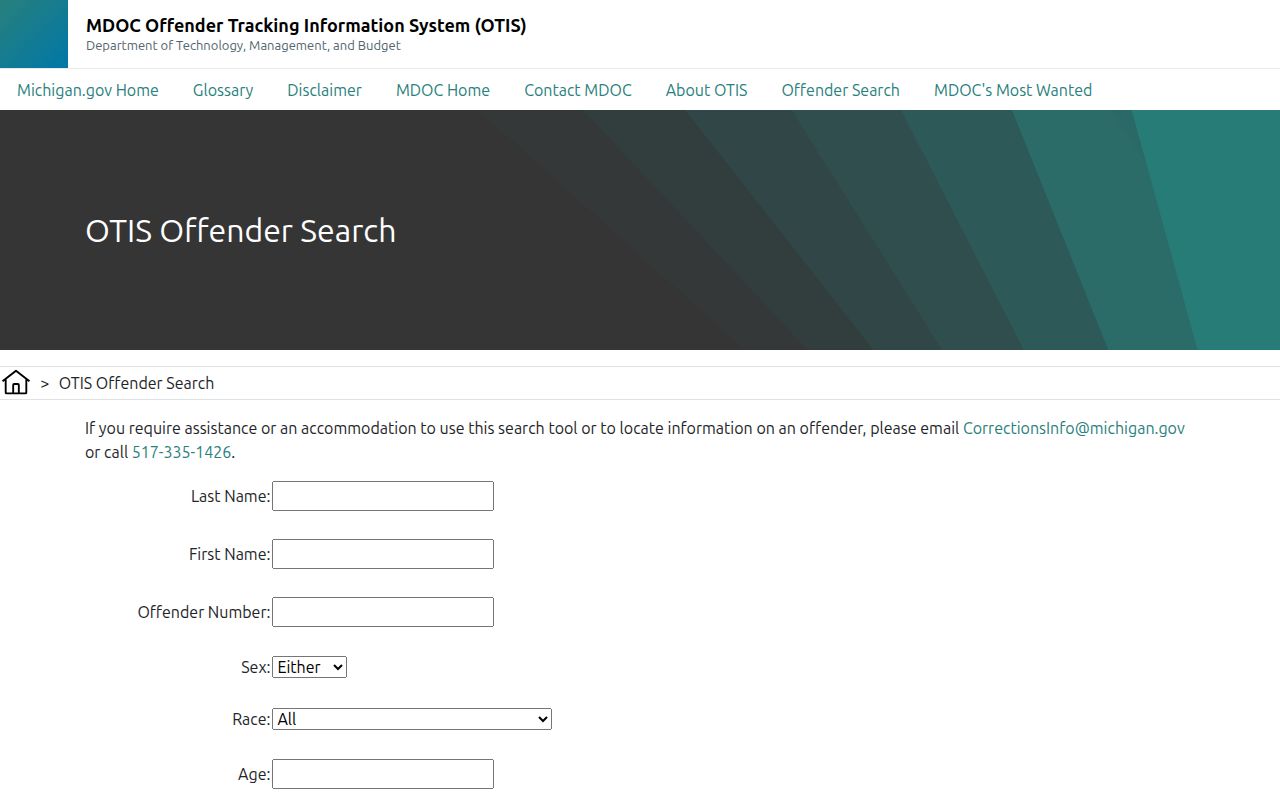
The result must be interpreted by status and sentence. A date standing alone is not proof that physical release occurred.
Read Alpena MDOC Release Dates
An OTIS profile can display MDOC Number, SID Number, Current Status, Assigned Location, sentence offenses, court file number, county, sentence date, Earliest Release Date, Date Paroled, Discharge Date, Supervision Begin Date, Supervision Discharge Date, and Discharge Reason. Not every profile contains each label, and multiple sentences may produce different dates.
- Earliest Release Date
- An eligibility or time-computation field, not a promised departure.
- Date Paroled
- The recorded start of parole after release from prison.
- Supervision Discharge Date
- The date MDOC records community supervision as ending.
- Discharge Reason
- The recorded reason a sentence or supervision entry ended.
A discharged profile may leave Earliest Release Date blank and show a final Discharge Date instead. A parolee can show Date Paroled and a later supervision date. Read the sentence-level reason rather than assuming every discharge represents the same event.
Profiles can contain several active or inactive sentences from different cases. Each may carry its own minimum, maximum, county, court file, and discharge information. One attractive date should not be lifted from that group and labeled as the final release. Identify which sentence controls and whether the terms run together or one after another. Court corrections, resentencing, jail credit, or a later MDOC update can change the displayed calculation.
OTIS Limits on Alpena Releases
MDOC says OTIS covers people currently under its supervision and people discharged within three years of their supervision discharge date. Most profiles fall outside public OTIS after that window. A record may disappear sooner after a court-ordered set-aside. The absence of an old result therefore does not erase the Alpena court case or prove that the person never entered MDOC.
OTIS is also not a complete criminal-history system. It does not archive Alpena County jail bookings or same-day bond releases. Sentencing data errors should be addressed through the sentencing court. A current status or assigned-office concern belongs with MDOC. For older matters, the court docket, judgment of sentence, and MDOC public-information request are the durable channels.
OTIS permits a wildcard after at least three leading characters in a last-name search. Status choices include Active Offenders, All, Prisoners, Parolees, Probationers, Discharged, Parole Absconders, and Probation Absconders. Use Discharged for ended MDOC jurisdiction and Parolees for conditional release from prison. An absconder label alleges noncompliance and must not be described as discharge.
Note: An Alpena roster disappearance followed by a prisoner status in OTIS shows a state transfer, not release to the community.
Michigan Dates After Alpena Sentencing
Michigan’s truth-in-sentencing rules do not use the federal 85-percent shortcut for the affected state sentences. MDOC explains that covered prisoners must serve 100 percent of the judicially imposed minimum before parole eligibility. That group includes specified assaultive offenses committed on or after December 15, 1998 and other offenses committed on or after December 15, 2000. Reaching the minimum places an eligible person within Parole Board authority. It does not require release.
Older offense dates can involve legacy credits under MCL 800.33 and MCL 791.233. Consecutive sentences, jail credit, court correction, parole action, a detainer, and data updates can alter the practical date. Informal arithmetic is unreliable. The Alpena County Release Date Lookup explains the state fields and the county-jail distinction in detail.
MDOC policy calls the internal earliest eligibility point the Parole Board Jurisdiction Date. Eligibility starts review authority; it is not a pickup date. The Time Computation Unit certifies dates after positive parole action, and the institution records office reverifies a release date shortly before departure. A detainer can also cause parole to another custodian instead of release into the community.
Parole After an Alpena Transfer
The Michigan Parole Board is the state paroling authority. A positive decision is not the same as physical release. MDOC’s public process says at least 28 days separates the Board decision and departure, while staff recheck calculations, plans, notices, detainers, and new information. A grant can be deferred, suspended, or rescinded before release.
After departure from prison, OTIS may show Parole and an Assigned Location. Alpena has a named field office for the service area, but the public record should not be used to expose an officer’s private schedule, a residence, or movements. Use the main office channel to correct or verify public status. Final discharge occurs later if MDOC ends supervision.
Michigan does not publish a single person-by-person calendar for every routine parole interview. Limited public hearings for lifer-law, commutation, and pardon matters follow a separate registration route and should not be confused with routine consideration. For an individual outcome, OTIS status, Date Paroled, the Board’s public channel, and an available decision record are more useful than the aggregate quarterly grant, deny, and defer reports.
Request Michigan Release Records
Start with OTIS, then use MDOC Public Information for a release, parole, transfer, or discharge record that is not shown publicly. Include the MDOC number, Alpena court file when known, sentence, and the exact record or date field. A focused request is easier to process than a request for every record about a person.
State correctional files can contain exempt security, medical, victim, personnel, and operational material. Ask for segregable public portions when a field is withheld. The Alpena County Sheriff can confirm only the local handoff to MDOC. It cannot certify a later state prison release or final MDOC discharge.
A state records request should describe an existing document rather than ask MDOC to calculate a new answer. Request the parole action, certified time computation, transfer record, discharge record, or specific sentence data that resolves the question. Include an observation from OTIS if a public field appears inconsistent, and direct a sentencing error to the Alpena court that issued the judgment.
Michigan Department of CorrectionsOTIS and state offender records
Official MDOC website
Public Information and FOIA
Alpena Jail Versus MDOC Release
The Alpena jail release transaction documents when county custody ended. OTIS documents the later state status. These sources can describe one continuous legal path without recording the same event. A county transfer date may precede state intake. A state parole date can occur years later. A discharge date may follow parole by another period.
For a complete timeline, pair the Alpena booking and transfer record with the judgment of sentence and the matching OTIS profile. The Alpena County released inmate search also compares MiCOURT, MI-VINE, BOP, ICE, and Sheriff records when the receiving system is unclear.