
Alpena County Parole and Probation
Parole and probation both permit a person to live in the community, but they come from different decisions. Parole is conditional community placement during a Michigan prison sentence. The Michigan Parole Board decides whether an eligible prisoner may serve the rest of that sentence outside prison, and MDOC Field Operations supervises the parolee. Probation is a court sentence served in the community. An Alpena County felony probationer may be supervised by MDOC, while a misdemeanor probation case may remain with the 88th District Court.
That split controls the search. OTIS can show a state prisoner, parolee, felony probationer, absconder, or recently discharged person within its public scope. It does not cover every county misdemeanor case. A person missing from OTIS may still be on District Court probation, while someone marked “Parole” has left prison but has not ended MDOC legal supervision. The following comparison keeps the terms separate.
| Point | Parole | Probation |
|---|---|---|
| Who orders it | Michigan Parole Board after a prison sentence reaches legal eligibility | Sentencing court as a community sentence |
| Public Alpena check | OTIS status, Date Paroled, and Assigned Location | OTIS for MDOC felony probation; MiCOURT and 88th District Court for local misdemeanor probation |
| Custody meaning | Out of prison, still under MDOC sentence supervision | In the community under court-ordered terms, sometimes without prior prison custody |
| End point | Parole discharge or maximum discharge recorded by MDOC | Court or MDOC discharge, depending on the supervising authority |
- Parole
- Conditional release from prison while the state sentence continues under supervision.
- Probation
- A court sentence served in the community under stated conditions.
- Discharge
- The end of the sentence or supervision tracked by the agency.
- Absconder
- A public status alleging that a supervised person stopped complying or reporting. It is not a discharge.
Verify Alpena County Release Supervision
Start with the sentence type, not the jail roster. The Alpena County current-inmate list answers whether a person is displayed in the jail now. It cannot establish parole, probation, or final discharge. Michigan’s Offender Tracking Information System is the first public source for a state prisoner or MDOC supervisee. MiCOURT and the local court supply the missing route for Alpena misdemeanor probation.
- Search OTIS by MDOC number when known. Otherwise use the last name, first name, and enough identity fields to avoid a same-name match.
- Read “Current Status” before any date. “Parole,” “Probation,” “Parole Absconder,” “Probation Absconder,” and “Discharged” have distinct meanings.
- Review “Assigned Location,” “Date Paroled,” “Supervision Begin Date,” and “Supervision Discharge Date” only when those fields appear on the matched profile.
- If OTIS has no result and local probation is possible, search MiCOURT for the Alpena 88th District Court case and read the latest probation and discharge entries.
- Confirm a public office through the MDOC directory or contact the court for procedural information. Do not use private officer details or attempt to track a person’s movements.
The successful manifest capture of the official OTIS search form shows the state portal used for this Alpena County supervision check.
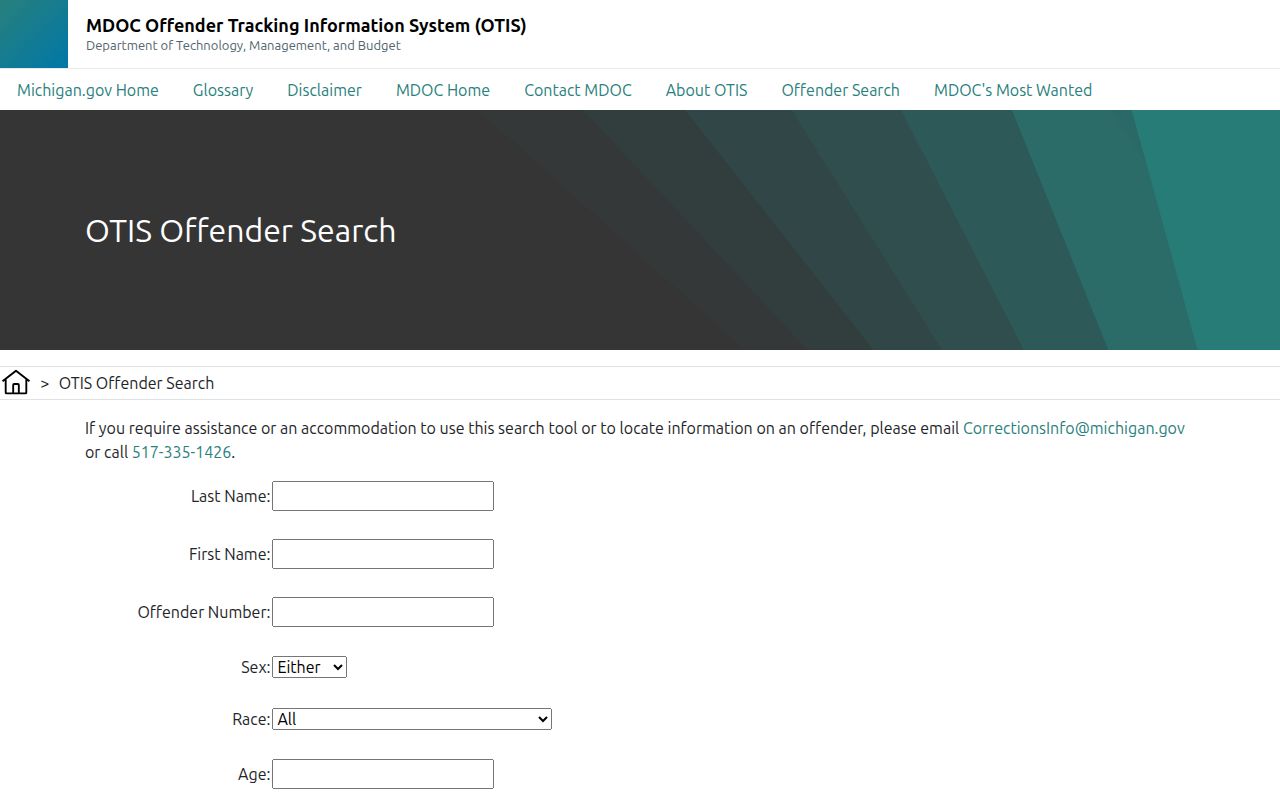
The form supports name, offender number, status, and identity filters, which makes it more precise than treating a vanished jail entry as proof.
Note: Save the date of each search because OTIS and court entries can change after an agency update or legal correction.
Alpena County Supervision Office
Alpena has a named MDOC field office. The official Region 3 directory lists Alpena County Parole/Probation, and the OTIS “Assigned Location” field can connect a public supervisee profile with the responsible office. Use the main office channel to correct an apparent supervision-status problem. Sentencing or court-data errors should instead go to the sentencing court, because the field office does not rewrite the judgment.
MDOC Alpena County Parole/Probation
703 W. Chisholm, Suite A
Alpena, MI 49707
989-354-3425
The MDOC Region 3 listing was also captured successfully for this project.
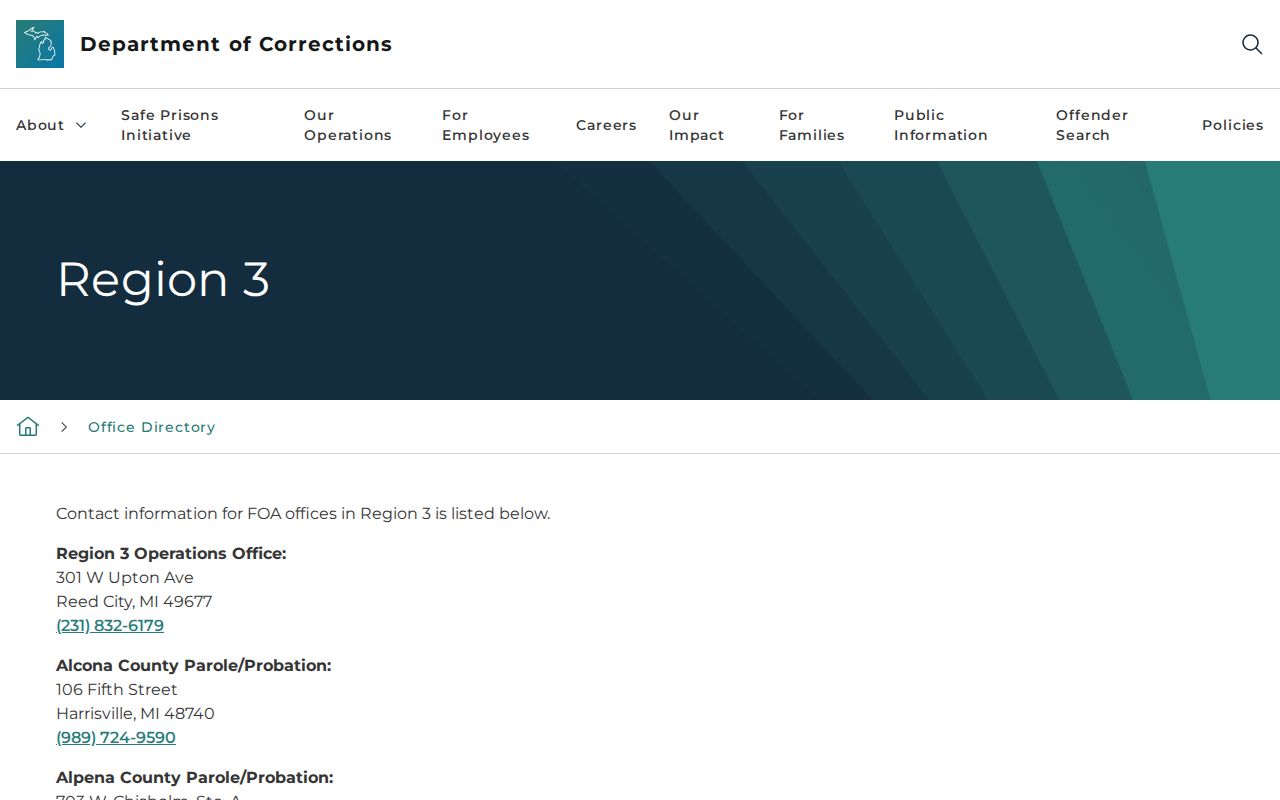
The listing confirms the public office route without exposing an individual officer’s schedule, private contact details, residence, or field activity.
Alpena County Court Probation
A local probation check can stop too soon if it relies only on OTIS. The 88th District Court handles misdemeanors punishable by up to one year and has its own probation function, information sheet, and reporting form. A misdemeanor probationer may therefore be absent from MDOC’s statewide system. Search the court case by party or case number, then look for the sentence, probation order, violation entries, warrant recall, or discharge.
The court is at 719 W. Chisholm Street, Suite 3, Alpena, MI 49707. Its published phone numbers are 989-354-9678 and 989-354-9681. The clerk can explain public record access and procedure, but the docket time is not the same thing as the exact time a person left the Alpena County Jail. The jail release transaction remains the best record of physical departure.
For a felony, all adult criminal matters begin in District Court, but a case that proceeds after bindover moves to the 26th Circuit Court. Check both courts when the case path is unclear. The broader Alpena County released-inmate search explains how the court record, jail release record, and OTIS status fit together.
Alpena County Parole Decisions
The Michigan Parole Board is the sole paroling authority for felony offenders committed to MDOC. Eligibility does not compel release. MCL 791.233 and 791.234 govern release prerequisites, eligibility, and special life-sentence procedures. A minimum or Earliest Release Date may open the review path, but the Board can grant, deny, or defer. Consecutive sentences, statutory exclusions, a detainer, an incomplete plan, or new adverse information can also affect departure.
Michigan does not publish a person-by-person calendar for every routine parole interview. Routine consideration often uses a secure video interview and file review. The public hearing registration page applies to limited Lifer Law, commutation, and pardon hearings, not routine parole reviews or parole-violation proceedings. MDOC publishes aggregate quarterly decision reports, but no official public database was found for searching every parole decision by a person’s name.
For one person, OTIS can display current status and Date Paroled. The Board or field office may confirm public information, and an available decision record can be requested. A grant still is not physical release. MDOC says at least 28 days separates a positive decision from departure, and staff recheck the time calculation before release.
Note: “Deferred” means the Board postponed a final decision for more facts or another condition; it does not mean parole was granted.
Alpena County Absconder Status
An absconder is not discharged. OTIS includes public status choices for Parole Absconders and Probation Absconders, and a matched profile may show that status. MiCOURT can add warrant or probation-violation context. Those records should be read as agency and court entries, not as permission to find, approach, or confront the person.
Conditions differ by sentence and order. At a high level, supervision may require reporting, compliance with court or Board terms, permission for certain travel, and completion of stated programs. A claimed violation can lead to investigation, a warrant, a hearing, or a change in status. It does not erase the need to confirm identity and read the latest record. Actionable safety information belongs with law enforcement, while record errors should go to the office or court that supplied the field.
VINE reports custody events from participating agencies, but it is not a supervision-decision database. A release or transfer alert cannot prove that parole or probation ended. OTIS, the supervising office, and the court remain the proper channels for Alpena County post-release supervision.
The Michigan Public Sex Offender Registry is also a separate status system. It can show an applicable registrant’s public status and offers registry-change alerts, but it is not an Alpena County parole or probation list. A registry “Absconder” label concerns the registry record and should not be substituted for an OTIS supervision status, while absence from the registry proves nothing about custody or supervision.
Alpena County Release Support
Alpena’s local reentry landscape includes a Sheriff-announced collaboration with Catholic Human Services. The announcement describes a social-work case manager and peer recovery coach at the Sheriff’s Office on weekdays to connect people with services. Local reporting also describes GED completion through the jail’s IGNITE programming. These are concrete transition resources, not guarantees that a released person will receive a certain outcome or remain compliant with supervision.
The distinction matters. A program contact can support the move from custody, but it cannot verify parole, probation, discharge, or a warrant. Those legal facts still come from OTIS, the field office, and the court. Likewise, a person who completed a jail program may later transfer to MDOC or another custodian rather than return directly to the community.
Alpena County Supervision Discharge
Supervision ends only through the authority that controls it. OTIS may show a Discharge Date, Supervision Discharge Date, and Discharge Reason for an MDOC case. Read the sentence-level reason because discharge can reflect successful completion, maximum discharge, another recorded termination, or death. Most people disappear from OTIS three years after supervision discharge, and a lawful set-aside may affect public display sooner. Court records then become the more durable procedural source.
A misdemeanor probation discharge is recorded through the 88th District Court, not transformed into an MDOC record. Request the probation discharge or register of actions when a durable copy is needed. If one source still shows active supervision while another appears closed, compare observation dates and ask the source agency to correct its own field. Do not convert a stale date into a claim that supervision ended.